Our roots
Know yourroots.
The long thread that brought plant fibre here, what the cloth is made of, why this label exists, and how a drop gets made.

01The lineage
An old thread,carried forward.
Plant cloth is not a trend we joined. It is a lineage this land has carried for eight thousand years.
c. 6000 BCE · Mehrgarh
The first thread
Cotton fibres mineralised inside a copper bead at Mehrgarh, in present-day Pakistan, date to the first half of the sixth millennium BCE. They are the earliest known cotton fibres in the archaeological record: plant cloth was already part of life in this region.
Read the archaeological record(opens in a new tab)The Vedic tradition
Plants worth praising
The Atharva Veda contains hymns to plants and their healing power. Later traditions associate bhang with that sacred plant vocabulary. Translations and identifications vary, but the underlying idea is clear: useful plants were named, studied, and treated with care.
Read the plant history(opens in a new tab)Medieval Ayurveda
Medicine, in measure
Later Ayurvedic and rasaśāstra texts record cannabis as bhangā or vijayā and describe prepared uses alongside dosage and adverse effects. The record treats it as a potent material to be handled deliberately, not a cure-all.
Read the medical history(opens in a new tab)The western Himalaya
The mountain cloth
Across the western Himalaya, hemp stalks have been retted, stripped, spun, and woven into cordage and cloth. A surviving 1885 fibre sample from Punjab now sits in the Smithsonian collection; the material history is physical, not imagined.
See the fibre record(opens in a new tab)1894 · The Empire
An inconvenient report
The colonial Indian Hemp Drugs Commission gathered evidence across the subcontinent. Its report distinguished moderate from excessive use and concluded that moderate use was generally not associated with appreciable harm — a more complicated record than the prohibition story that followed.
Explore the commission report(opens in a new tab)1985 · NDPS Act
The line, and what it left standing
India’s central law defined cannabis around resin and flowering or fruiting tops, excluding seeds and leaves when they are not accompanied by those tops. It also allows governments to permit cultivation for fibre, seed, or horticultural purposes.
Read the Act(opens in a new tab)2016 onward · Uttarakhand
The return to cultivation
Uttarakhand became the first Indian state to regulate hemp cultivation and later issued the first commercial pilot licence for high-quality fibre. The return is licensed and measured, but it reconnects the crop with one of its oldest uses.
Read the legal survey(opens in a new tab)Now · Rootwear
You are wearing the rootline
Rootwear is a continuation: hemp grown as a crop, spun into cloth, and carried into a new garment. Every drop is a small act of remembering. You are holding one end of a very old thread.
See the current drop
Grown slow. Worn loud. Rooted deep.
We did not start this. We are refusing to let it be forgotten — and asking you to wear it knowing what it is.
Rootwear — Established in Process.
Join the line02The fibre
It beginsas a stalk.
Hemp is a bast fibre. It is stripped from the stem of Cannabis sativa rather than picked from a seed head, and that one difference explains almost everything about how the cloth behaves.
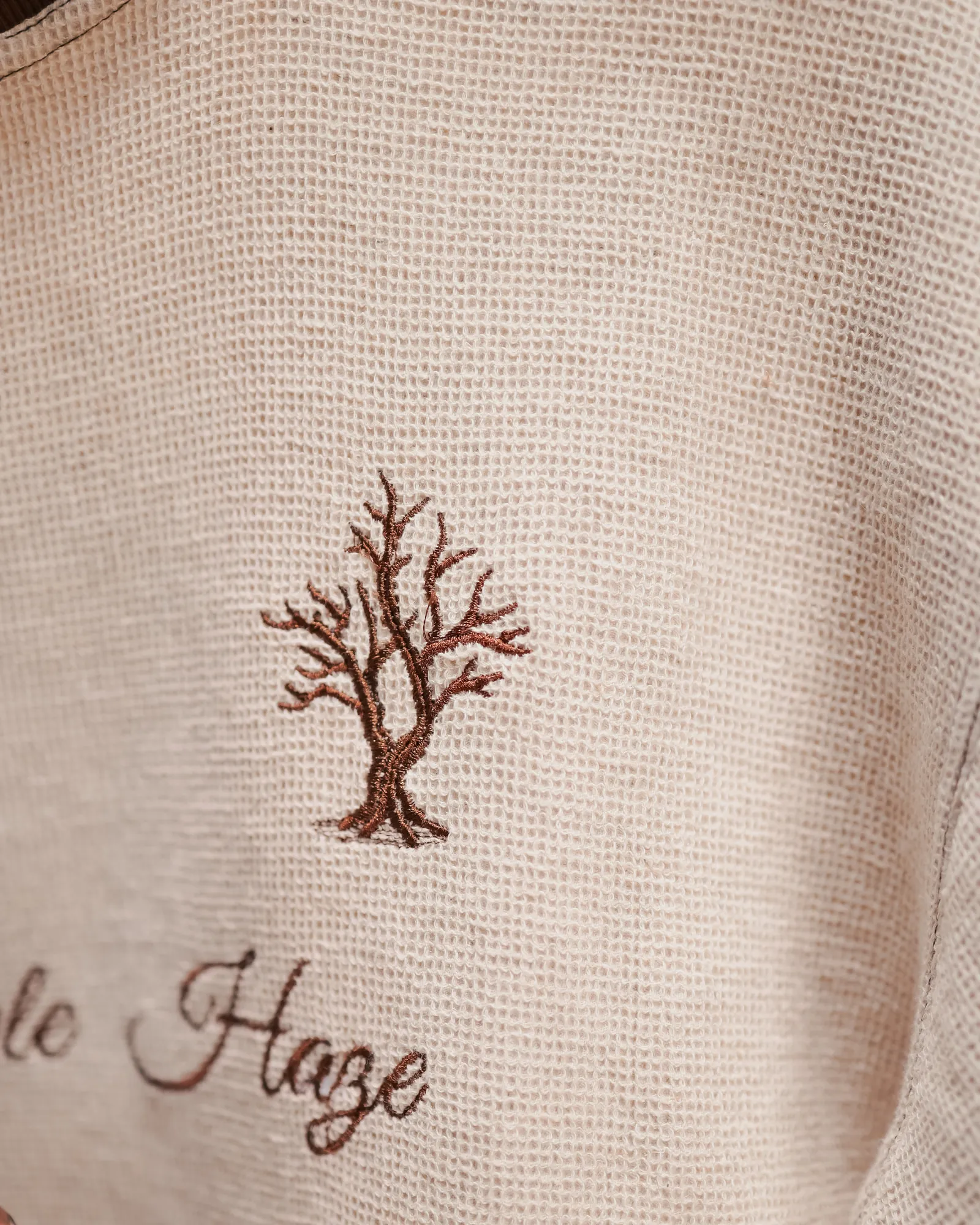
Cotton grows as a seed hair: short, fine, spun into a soft and round yarn. Bast fibre runs the length of the stalk in long bundles held in the plant’s outer layer. Separated and spun, those bundles give a yarn with a longer staple and a flatter cross-section.
Longer staple means fewer fibre ends at the surface of the yarn. Fewer ends means less surface fuzz, less pilling where a bag strap sits, and a cloth that keeps its face after a year of wear instead of blooming into a haze.
It is a firmer hand out of the parcel. Hemp-led cloth arrives with body to it — it holds a fold and it falls away from the shoulder rather than clinging to it. Then it softens, and it keeps softening. The shirt you unwrap is not the shirt you will own in six months.
- Bast fibre
- Taken from the stem, not the seed head. Long bundles rather than short hairs.
- Staple length
- Fewer fibre ends at the yarn surface, so less fuzz raises over time.
- Hand
- Firm on day one, softer every wash after. The break-in is the point.
- Drape
- Weight instead of cling. It hangs off the frame rather than following it.
- How it ages
- Takes a crease, takes a fade, keeps a shape. It records how it was worn.
The blend
Rootwear runs hemp at 30% against 70% cotton. The cotton carries softness from the first wear; the hemp carries the body, the staple length and the way the cloth ages. 180 GSM is a mid-weight jersey — enough to hang properly, not so much that it stops being wearable through an Indian summer.
- 30/70 hemp to cotton, by composition
- 180GSM fabric weight
- 25 hand-numbered pieces in this drop
- 05 sizes, cut unisex
03The label
Establishedin Process.
Rootwear is not a catalogue. It is a sequence of drops, one at a time, each one finished before the next begins. The drop is the object.
01
One strain at a time
Each drop is named for a single strain and built around it — one story, one palette, one cut. When it is finished it is finished. The page stays up; the pieces do not come back.
02
25 pieces
A drop is 25 hand-numbered pieces. Not twenty-five thousand with a limited-edition sticker on the neck label. The number written on yours is the number that was made.
03
India only
We ship within India only. Every price on the site includes GST.
04
Sold nowhere else
No marketplace listings, no resellers, no third-party storefront. If it did not come from this site, it did not come from us.
05
Nothing is ever taken down
A finished drop keeps its page, its photographs and its story — a lasting record of every piece we have made.
Built from the ground up.
04The making
How a dropcomes to exist.
Five stages, each done by hand — which is why there are only 25 pieces in a drop.
- 01
The cloth
The blend is fixed before anything else: 30% hemp, 70% cotton, knitted at 180 GSM. The weight is chosen for the cut, not the other way around.
- 02
The cut
One unisex block, graded across XS — XL, cut to the same measurements every time. Exact chest and length measurements are on the size guide. The fit is oversized. Women may want to size down.
- 03
The artwork
The back carries the drop’s artwork. It is set once and proofed on the actual cloth rather than on paper, and it is never rescaled to fit a different garment.
- 04
The hand-numbering
Each finished piece is numbered by hand, 01 through 25, on the label. Your number is yours alone, recorded against your order.
- 05
The dispatch
Packed and sent by hand, with your piece number on the note. Pre-orders ship once the balance is paid.
Where this goes next
One strain.25 pieces.Then the next one.
Small runs, made with care. See the current drop, or browse the ones that came before.